The Human Internet Is Over. Are You Building for the Bots Yet?

For the first time in history, machines use the internet more than we do. If your product still expects a human to find it, you are optimizing for a world that no longer exists.
Sometime in the middle of 2026, a quiet line got crossed that most marketing teams still have not noticed.
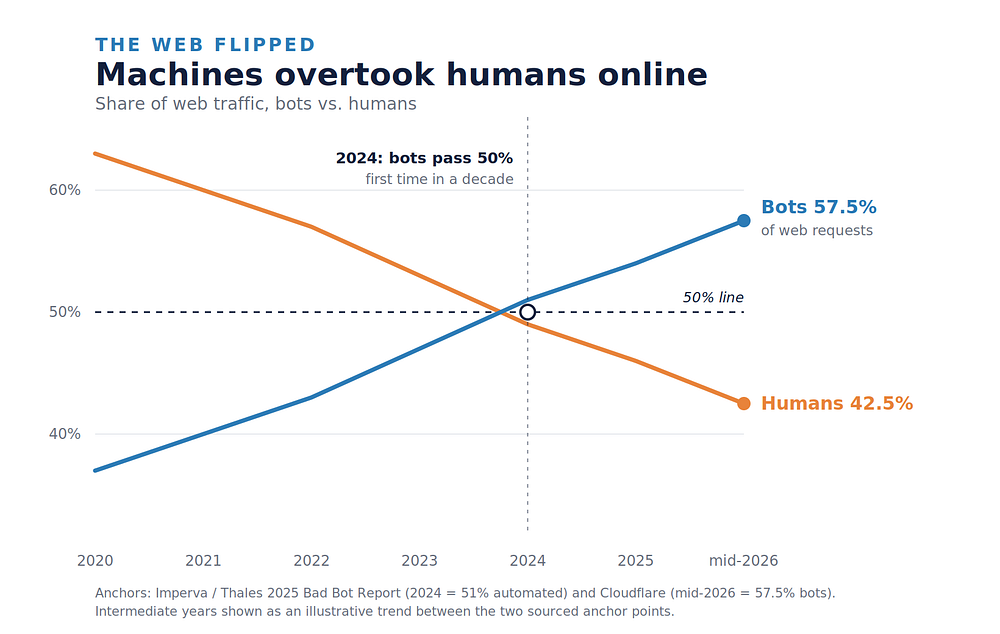
For the entire history of the internet, the assumption underneath every website, every ad, every “click here” button was simple: a human being is on the other side of the screen. That assumption just broke. According to Cloudflare, bots now account for roughly 57.5% of all requests to web content, and humans for about 42.5%. Cloudflare’s CEO had publicly predicted this crossover would happen in 2027. It arrived early enough that he went on X and essentially said, well, that happened faster than I thought.
So congratulations, humans. After decades of being told we were hopelessly addicted to the internet, we are finally not the ones using it the most. The catch is that the traffic replacing us is not idle. It is AI agents, crawlers, and assistants moving through the web on our behalf, and they behave nothing like us.
Here is the picture that should keep every C-suite person,founder and marketer up at night. When a person shops for a camera, they might open five tabs. When an agent shops for that same camera, it visits five thousand pages, reads them, compares them, and hands its human a single recommendation. That is not a small shift in volume. It is a different internet with a different customer, and that customer is the one now standing between your product and the human who pays for it.
Let me walk you through what this actually means, point by point, and then exactly what to do about it.
1. SEO is dead. GEO is the new growth engine.
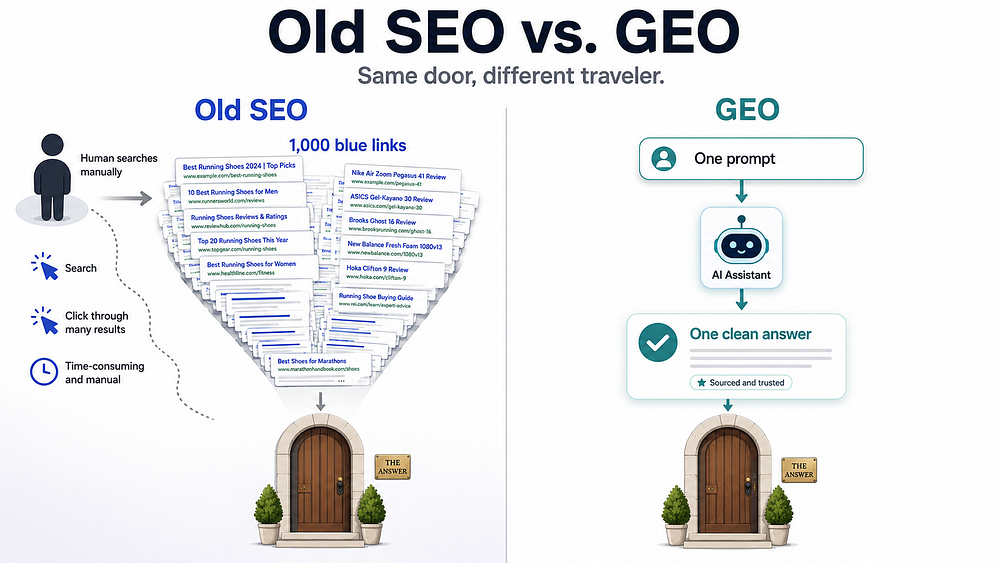
The door to the internet is still wide open. The question is only who walks through it, and it is no longer a human clicking every blue link.
Think about how you actually search now. You do not open Google and grind through ten pages of results. You ask ChatGPT, Perplexity, Gemini, or Claude a question, the model quietly reads a huge slice of the web for you, and it brings back the one answer you wanted. Everyone is starting to search this way. So if you are still building on the belief that a human will patiently click through a thousand links until they stumble onto you, you are building for a customer who has left the building.
This new discipline has a name: Generative Engine Optimization, or GEO. Old SEO was about ranking on a page a human scrolls. GEO is about being the source an AI chooses to cite when it answers a question out loud. It is not the same game. There is a growing best practice of publishing an llms.txt file at the root of your site, a clean, curated index that tells language models what your site is and what matters on it. There are new crawlers to account for, like GPTBot, ClaudeBot, and PerplexityBot, and a lot of sites are accidentally blocking the very machines they now need to be seen by.
And there’s apart nobody mentions because it does not fit the doom narrative: the traffic that does come through AI recommendations converts far better. Independent measurement puts AI-search referrals at roughly four times the conversion rate of ordinary search, because by the time a human sees your name, an agent has already pre-qualified you for them. You are not fighting for a click anymore. You are fighting to be the recommendation.
Making yourself readable to agents can be as simple as adding an LLM-friendly layer to your site. That is the on-ramp. (And yes, this is exactly the kind of thing I help teams set up, more on that at the end.)
2. Structure your data, or the machines will ignore it.
Now the deeper move, and this is the one most people,yes looking at you, skip.
You need to sort through your data and build it differently for agents, because you and a machine do not see information the same way. You have intuition. You can glance at a messy pile of content and instantly understand what it is about. A language model cannot. Structure is not a nice-to-have for it. Structure is the difference between being understood and being noise.
Yes, There is the proof, and it is worth a lot of money. What you ask? lets me take you back abit: Reddit, know about it? Reddit made a fortune when the AI wave hit. Google reportedly paid around 60 million dollars a year for access to Reddit’s content, and OpenAI reportedly paid something in the range of 70 million. In total, Reddit’s AI licensing pulled in roughly 130 million dollars in a single year, about a tenth of its revenue.
Why Reddit and not everyone else? Because Reddit’s data was already sorted. Every subreddit is a topic. Every topic holds discussions about that topic, ranked by a community voting system, in real people’s real words. Google’s own search executive praised the deal for giving them “structured access.” That word, structured, is the whole story.
Now compare that to a typical social feed. One minute you are posting about your beach trip, the next you are ranting about who should have won a the Love island finale. To a human that is just a normal timeline. To a language model it is a mess that takes enormous work to sort, label, and make sense of. It is expensive to learn from. Reddit handed the machines a library. Most platforms hand them a junk drawer.
The lesson for your brand is direct. If your product information, your story, and your proof are scattered across the internet in a dozen inconsistent forms, you are not giving AI agents more to work with. You are giving them more work to do, and they will route around you toward whoever made it easy. Clean, consistent, topic-organized, fact-dense content is the new curb appeal. Build the library, not the junk drawer.

3. Half the web is already AI-made. Stop apologizing and start doing it well.
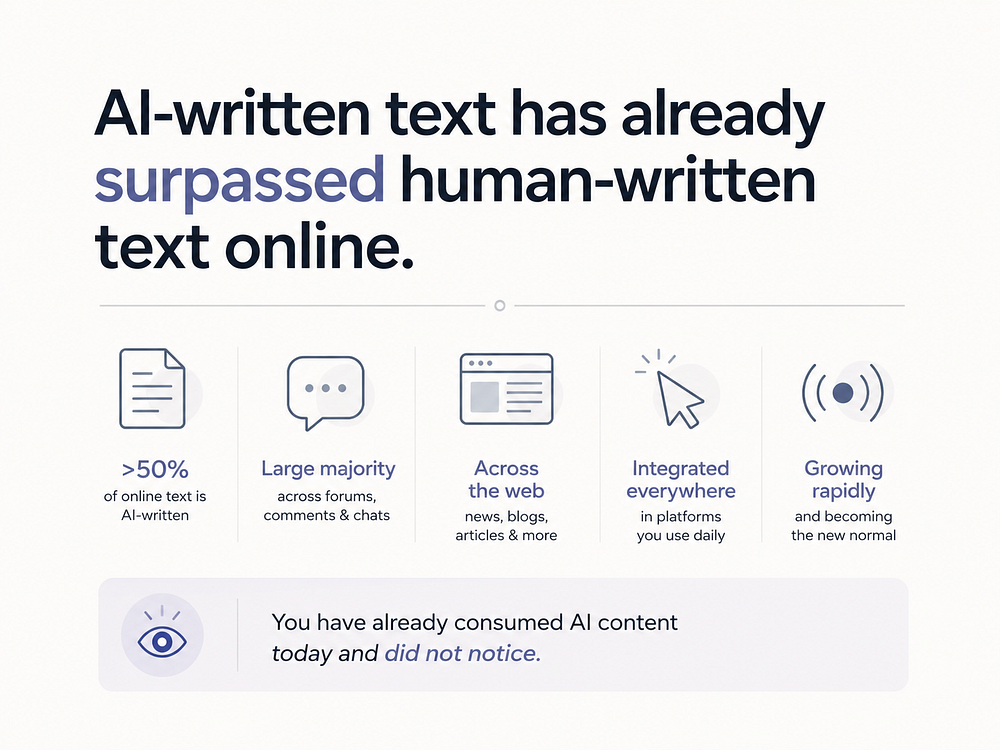
Ready for an uncomfortable fact. AI-written text has already overtaken human-written text online. It happened before the traffic crossover did. And most people cannot tell the difference, because the technology is genuinely that good.
You know the “AI slop” complaint. I think it is a red herring that is about to be quietly disproven. Yes, you have that aunt or uncle who forwards you videos that scream “fake” to you but look completely real to them. Fine. But be honest with yourself: you have also consumed AI-generated content and had no idea. It is in the music you stream, the videos you scroll, the copy in your inbox, the summaries in your news. The clean line between “real” and “AI” is already gone for the average person.
So you have two options. Pretend it is beneath you, or get on board and do it better than the competition. I would do it well.
Here is where it gets kinda interesting, and where you flip the whole thing from a threat into an edge. Think from first principles. If I am marketing the new Nike drop, my question is not “how do I write another product description.” My question is: what can I tell a model about this product that is not already online? Whatever that is, that is my advantage, because the machine can only recommend what it can find, and right now it can only find what everyone already published.
This reframes even the thing people fear most. Hallucination, in a creative marketing context, can be a feature and not a bug. The best advertising has always thrived on the not-yet-seen, the image nobody had in their head until you put it there. That is what Cannes has rewarded for decades. Used deliberately, these tools are engines for generating what does not exist yet. The trick is to point that power at originality, not at churning out the tenth generic flyer this week.
4. The Dead Internet Theory, and the older instinct underneath it.
There is an idea floating around called the Dead Internet Theory, the notion that the web is slowly becoming machines talking to machines, with humans as spectators. So the honest question: will your company one day be browsed almost entirely by agents? Will you keep a readme file at your door purely for the crawlers? Fully? Probably not soon. Partly? It is already happening.
But I want to make a bigger, more human bet about where this all lands, and it runs against the doom.
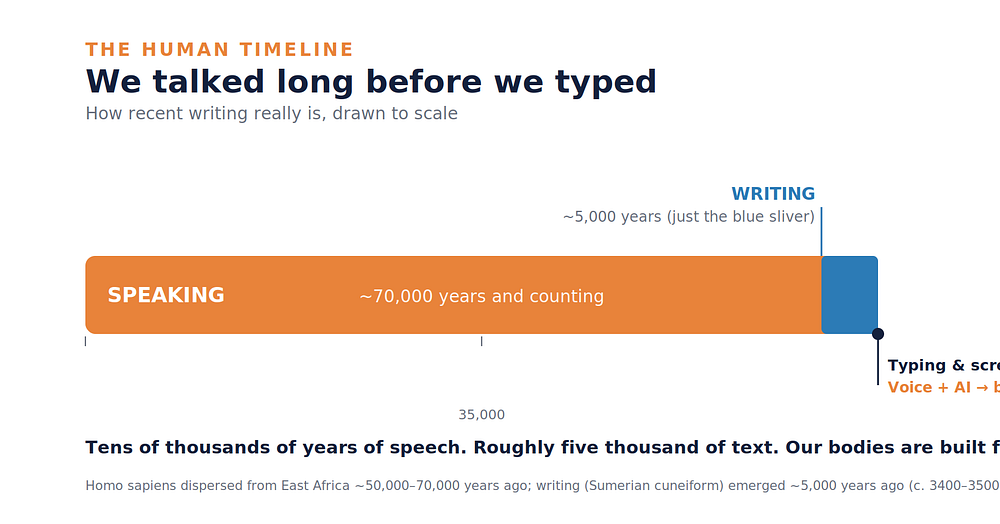
We have been a talking species for far, far longer than we have been a reading and writing one. Our ancestors walked out of East Africa (my home) somewhere between 50,000 and 70,000 years ago, already speaking. Writing, real written language, is only about 5,000 years old. It shows up with Sumerian cuneiform pressed into wet clay around 3400 to 3500 BCE. So put the ratio in front of you: tens of thousands of years of speech, roughly five thousand years of text. Our technology has sprinted ahead. Our bodies have not moved. We are still built for the voice.
That is why I think this ends with us doing more talking, not more typing. When a tool comes along that takes us back to what our biology already prefers, adoption is fast and it feels natural, because it is natural for us. Look at podcasts. They pulled bigger numbers than written media for exactly this reason. The friction of reading and typing was always a tax on our attention, and audio removed it. The head of OpenAI has talked openly about a near future where you get an enormous amount done from a short spoken conversation with a model, and about how heavily young people already lean on these systems. Now add smart glasses and ambient devices that strip out the keyboard entirely, and the direction is obvious. Less clicking. Less typing. More speaking, to machines that then go do the clicking for us.
That is the real shape of the shift. Not a dead internet. A spoken one, with agents as the hands.
So what does all of this actually mean for you?
It means the marketing playbook needs to be rebuilt, not touched up. A few concrete moves.
Hire AI-aware marketers, or at minimum run an honest AI audit of how you show up. You cannot manage what you refuse to look at.
Stop treating AI as a shortcut for cheap output. Too many teams use it only to crank out throwaway videos and lazy flyers they could not be bothered to hire a real designer for. That is the least valuable thing these tools can do. The valuable thing is structural.
Put your marketing team and your engineering team in the same room. Real AI integration lives at the seams between content, data structure, and code. You do not need people who only know how to close a semicolon and ship a feature. You need people who understand the business end to end, from the engineering tinkering to the design to how a customer is actually discovered. That full-stack understanding of the problem is the whole point.
Take agent-era advertising seriously now. The relationship between brands and agents that shop and browse on our behalf is going to be enormous, and genuinely different from anything we have run before. Being early here is a moat.
Understand how and why AI describes you the way it does. When a model mentions your brand, it is making choices based on what it can find and how well it is organized. If your marketing team is not already working with agents, they are, bluntly, behind. I am not even a marketer by title, and I can see it plainly.
The bottom line is two sentences. You need visibility, because you cannot optimize what you cannot see. And you need to work with agents, because at this point that is simply what using the internet has become.
Why I am the one telling you this
The why behind all of this is what you just read. AI is not going anywhere, it will touch every sector, and marketing has to catch up rather than dabble. The how is the part I actually do.
I have been building on the live edge of this for years, not talking about it from the sidelines. My own work is the proof of concept: my portfolio at olimiemma.com, my african themed party game laba party, and AXAM, an offline-first AI education platform I designed and built to reach places the rest of the internet forgets.
I build the sites, structure the data, and think about how machines read all of it, because that is the skill set this moment demands.
If your brand needs to be found and correctly understood in an internet that is now more machine than human, that is exactly the problem I help solve. Reach out and let us talk about what your visibility actually looks like from the other side of the screen, where the agents are standing.
The human internet had a good run. The next one is being written by machines that only recommend what they can find and understand. Make sure that is you.
If this was useful, follow along. I write about AI,Data and People and what it means building for the real world, plus the parts of this shift that most people are still pretending are not happening.


Comments
Post a Comment